EdTech Revolution Case Studies Maritime AI Workshop
Case Study Maritime & Shipping · Singapore

AI Upskilling for a Global Maritime Sustainability Team

A fully customised 3-hour intensive workshop — built around four real workflows, real files, and the team's actual Microsoft AI tools. No generic demos. No off-the-shelf content.

12
Participants trained
4
Live workflows automated
3 hrs
Hands-on intensive session
0
Generic demos used
3-Hour IntensiveOn-Site · SingaporeCustomised to Their WorkflowsMicrosoft Environment
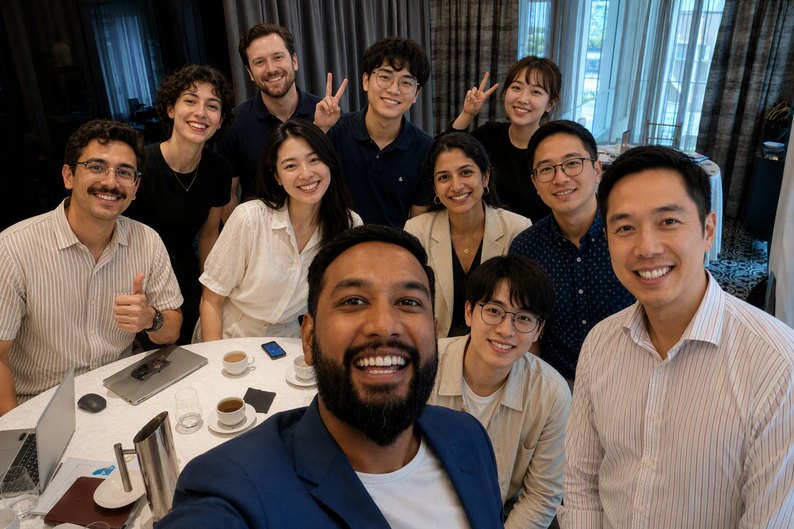
Maritime sustainability team after the AI workshop, Singapore
The Client

A cross-functional sustainability team in global energy shipping — spanning Strategy, Planning & Performance, and Enterprise Risk Management. Their daily workflows centre on Excel financial modelling, regulatory reporting, long-form ESG documentation, and board-level communications. Errors in a CO₂ tracking model or inconsistencies in a sustainability report don't just waste time — they create compliance and reputational risk.

Industry
Maritime & Shipping
Global energy logistics and fleet decarbonisation
Team Profile
12 professionals
Ages 25–50, mixed digital fluency from basic to advanced AI familiarity
Format
3-hour intensive · on-site
Singapore · Microsoft environment (Copilot-based)
Stakes
High compliance risk
CO₂ tracking errors or ESG report inconsistencies create regulatory and reputational exposure
The Challenge

Despite a highly capable team, four core workflows were consuming disproportionate time — all repetitive, error-prone, and ripe for AI augmentation.

Sensitivity modelling in Excel
Running decarbonisation investment appraisals across Downside, Base Case, and Upside scenarios — manually checking that every figure references the correct column's assumptions.
Fleet CO₂ data integrity checks
Verifying that monthly fuel consumption, emission factors, and CII ratings were internally consistent across a multi-sheet tracking model — significant manual cross-referencing required.
ESG report quality assurance
Checking 50+ page sustainability reports for grammar errors, inconsistent terminology, and data drift across sections written weeks apart by multiple contributors.
Board-ready slide creation
Distilling dense performance data briefs into concise, executive-ready presentation outlines under time pressure before board meetings.

"I've been doing this by hand for years." — The moment that defines why this work matters.

The Solution

EdTech Revolution designed and delivered a 3-hour intensive built entirely around the team's real workflows, real file structures, and real pain points. The facilitator guide was rebuilt from scratch — not adapted from a template.
01
Workflow-first design
Every exercise was mapped directly to a task the team performs regularly — not invented for the workshop.
02
File-authentic exercises
Demo files replicated real model structures — including a 52-page sustainability draft with 33 planted errors for the QA exercise.
03
Tool-contextualised
All exercises built for the AI tools the team actually has access to in their Microsoft environment — not a neutral demo platform.
04
Mixed-fluency instructional design
Grounded in Gagné's events of instruction and Kolb's experiential learning — accommodating ages 25–50, basic to advanced AI familiarity.
The Four Hands-On Exercises
01
Sensitivity Audit
Prompt AI to cross-check scenario assumptions in a decarbonisation investment model and flag the top 3 errors by materiality. Participants worked with a file that mirrored their real Downside/Base Case/Upside appraisal structure.
02
CO₂ Data Integrity
Use AI to verify monthly fuel-CO₂ consistency, check annual totals, and validate CII ratings against boundary tables — across a multi-sheet tracking model that replicated the team's real file structure.
03
Report QA — 52 Pages, 33 Planted Errors
Most Impactful
Run a 52-page sustainability draft through AI to surface grammar, spelling, and consistency issues with page-level references. The document was engineered with errors spanning grammar, data inconsistency, and ESG terminology drift — realistic enough that the team didn't know which errors were planted.
04
Board Slide Outline
Live Output
Turn a performance data brief into a 6-slide board-ready outline with headline takeaways and chart recommendations — under the same time pressure participants face before real board meetings. Every participant completed and reviewed their output in the room.
Facilitator
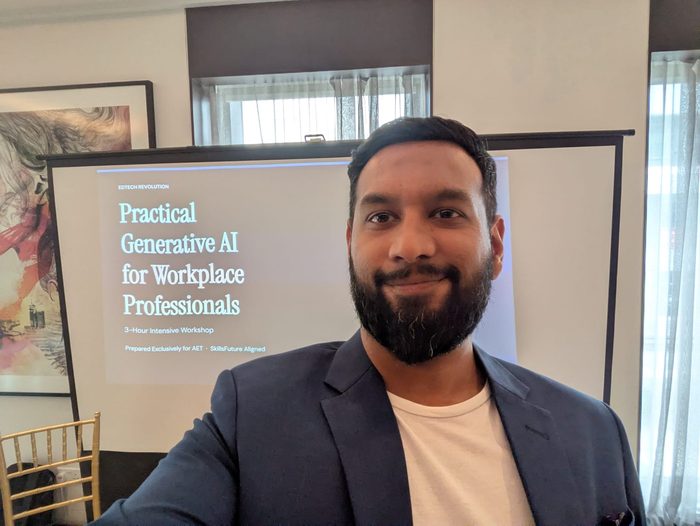
Camil Toorabally
AI Upskilling & Performance Specialist
  • NACE Workplace Learning Consultant · Temasek Polytechnic
  • Former AWS EdStart Accelerator Lead, Asia Pacific
  • MSc · Emlyon Business School · ACLP & DDDLP · IAL Singapore
Camil Toorabally facilitating the AI workshop
The Outcomes

By the end of the 3-hour session, every participant had personally completed all four AI-assisted workflows using tools available in their own work environment.

01
Hands-on competency from day one
All four AI-assisted workflows completed live, using tools already in the team's Microsoft environment — practised, not watched.
02
A reusable prompt library
Tailored to the team's four highest-priority workflows — a working toolkit built during the session, not a generic starter pack.
03
Demonstrated time savings
Tasks that previously took hours completed in minutes — demonstrated live, not claimed in a slide deck or promised in a brochure.
04
A shared team language
A common vocabulary around AI adoption across the sustainability department, reducing friction for future implementation and experimentation.

The goal was never to impress them with AI. It was to make their actual work feel lighter — and leave them confident enough to keep going on their own.

Why It Worked

Generic AI workshops produce generic results. What made this engagement different was the depth of preparation applied before a single slide was shown.

The facilitator guide was rebuilt from scratch around the client's industry context — maritime sustainability, decarbonisation finance, and ESG reporting — not adapted from a general AI training template.
Demo files were engineered to mirror real model structures. The 52-page QA document contained 33 carefully planted errors spanning grammar, data inconsistency, and ESG terminology drift — realistic enough to feel genuine.
Instructional design grounded in proven methodology — Gagné's events of instruction and Kolb's experiential learning cycle — applied invisibly, without academic overhead visible to participants.
The learning journey extended beyond the room through iQMA's AI coaching scenarios, giving participants a way to continue self-directed practice after the session ended.
Related Case Studies

Ready to bring this to
your team?

No lengthy procurement process · Deployed in 2 weeks

Book a discovery call View all programmes